PORTRAIT | LANDSCAPE | STILL LIFE | DRAWINGS
Wei Lin: Painter
Jeff Kelley
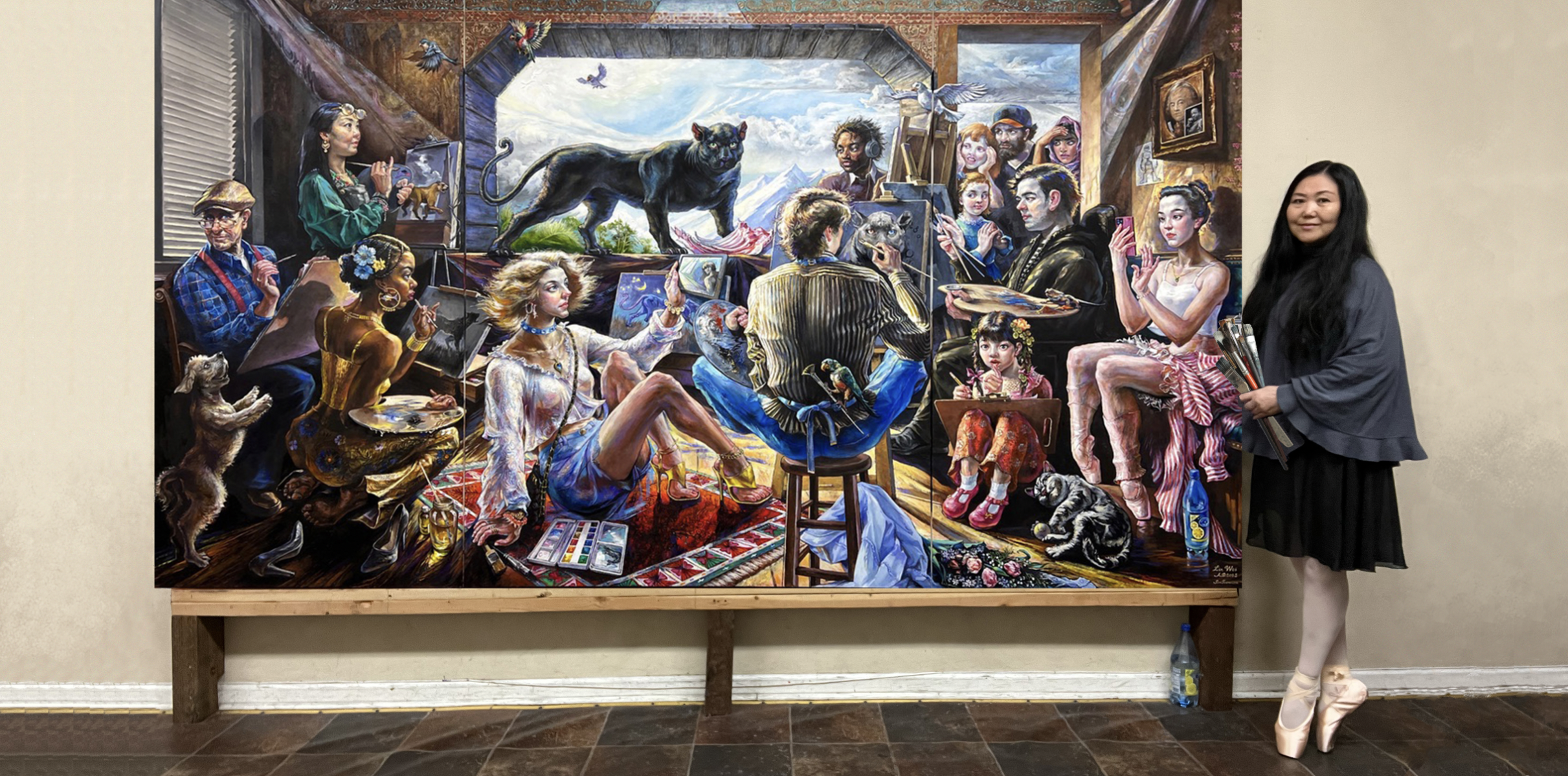
Lin Wei in front of her work From Life (2025)
For painter Wei Lin, art has always been the way to tell a story. Born in Qiufu, China, (Confucius’ hometown) Lin drew and painted from an early age. As she grew, she trained at the Shandong Art Institute and, later, at the Central Academy of Fine Art in Beijing, where she adopted the official style of Chinese Socialist Realism. She was not drawn to propaganda, though, preferring to see in a painting the sweeping narrative arcs of her subjects – almost all of whom are women. Heroic women who undertake epic journeys in life, like she has.

I first met Wei Lin in 1998 when she spoke at Mills College in Oakland, having been invited there from China by the artist Hung Liu. Her English was halting, but via Liu’s steady translation a story emerged. Knowing of Liu’s work at the Central Academy, Wei Lin was determined to emulate her hero’s journey by coming to the US. The hard work of being a painter paralleled that of marrying and having two children, as well as becoming an American citizen. All were stories – crossing the sea, into a new language, another family and society. But crossing from one nation’s official painting style to another’s expectation of constant artistic innovation can be an endless journey. Lin kept the socialist realist style but turned the canvas toward herself – her (and her family’s) journeys became the subjects of her paintings as she reimagined herself crossing the divides of national history and personal identity. She reinvents her story with each new work.

Lin is a highly trained painter and applies the brush with confidence. Her search for meaning, however, lies not in experimenting with the medium, or with ideas about new art, but in illustrating stories about her personal migration from China to America, and to the San Francisco Bay Area in particular. Thus, she is primarily a self-portraitist, but each depiction identifies her with heroic women (and sometimes men).

In a self-portrait as Mona Lisa, for example, she dominates the foreground, a cascade of black hair falling onto an amber robe draped from her shoulders, close to the color of Da Vinci’s famous portrait, except for a red, Chinese-style blouse with a Mandarin collar underneath. And a wedding ring on her softly limp hand. The background, also, compresses a fanciful pastiche of San Francisco landmarks – the Transamerica building, the famous row of “painted ladies” Victorian houses, the Golden Gate Bridge (with lots of tiny artists painting the scene from easels) – into the space around her head.

In other self-portraits, Lin substitutes her own likeness for those of significant women artists (Frida Kahlo, Elisabeth Vigee Le Brun, Emily Vernon), famous images of women in European painting (by John Singer Sargent, Johannes Vermeer, Vincent Van Gogh), and, in one case, an early 20th century self-portrait of Pan Yu Liang, perhaps the most influential female Chinese artist of her time.

These and other paintings, parts of “The After Greatness Series,” situate the artist in the guises of other famous women. How must it feel to paint one’s own face atop the poses of other women? Do you imagine your consciousness from another’s point of view? Do you imagine watching as the original artist paints you? Does your self-awareness split in the moment? Do you feel adorned as your subject is adorned? It’s an interesting predicament Wei Lin puts herself in. The act of painting one’s likeness of (and on) the famous images of other women – especially since women have so often been appropriated in the history of art – involves replacing them with yourself, but also of surrendering your identity, temporarily, to the aura of another’s painting.

The ambition of Wei Lin’s “After Greatness” series is to identify with greatness as a woman artist. But what makes these paintings her own is the way she adds personally symbolic imagery to the backgrounds of her (self) portraits. It’s the little things that matter: a gold dragon filigree painted on the turban of Vermeer’s girl with a pearl earring; Chinese calligraphy painted on the drapery behind Lady Agnew of Lochnaw by Sargent; a panda on the shoulder and red roses in the hair of Kahlo; a Tai Chi dancer on the painting palette on Vigee Le Brun. These added images suggest stories about the “background” of the artist, her Chinese homeland, her American hometown. They are also the artist’s personal touchstones for paintings that associate the painter with “greatness.”

Other paintings celebrate the artist’s journey from an ancient land to America. We see in the backgrounds the Pacific Ocean, sailing ships, the Golden Gate Bridge, and the Statue of Liberty appear as well as the ghosts of ancestors from the artist’s (and China’s) past. In several cases, Lin portrays herself sitting in the foreground – literally sitting on the ground – painting a canvas on easel with her back to the viewer. Her arms and back are meaty, not thin like traditional Chinese beauties, but more like the earthy figures in Mexican murals or the simplified, neo-primitive forms of early Cubism.

In the painting “Prayer,” Lin paints a portrait of the head of the Statue of Liberty, the bloodied points of her crown spiking beyond the canvas, while the whole statue, in the distant background, stands above a smoldering horizon of billowing black and reddish-brown clouds. A fleet of little paper boats, folded like origami, wash onto the shore where the artist sits. Each flies a tiny American flag. The year of this painting is 2020, obviously a time of great strife. The points on Lady Liberty’s crown are red, suggesting the spikes of a corona virus; the little boats suggest the returning souls of the departed. The clouds are churning and warlike, as if the nation had been pounded by warships, or hit by planes. We see the back of Lin’s head, and her broad, masculine shoulders and arms. She is strong, but also older – her braided hair is white, suggesting the toll this era has taken.

Wei Lin’s painting style derives from academic realism, but mixes and softens with the bold colors and simple patterns of Chinese folk art. This mixture animates her canvases, and yet grounds them in personal experiences. Her ethic is hard work, which is why she is a respected teacher of art to children. Her themes are immigration to America, Chinese family values, the ambition of women, and the liberty and discipline of being an artist. That’s what she came here to be.

December 2019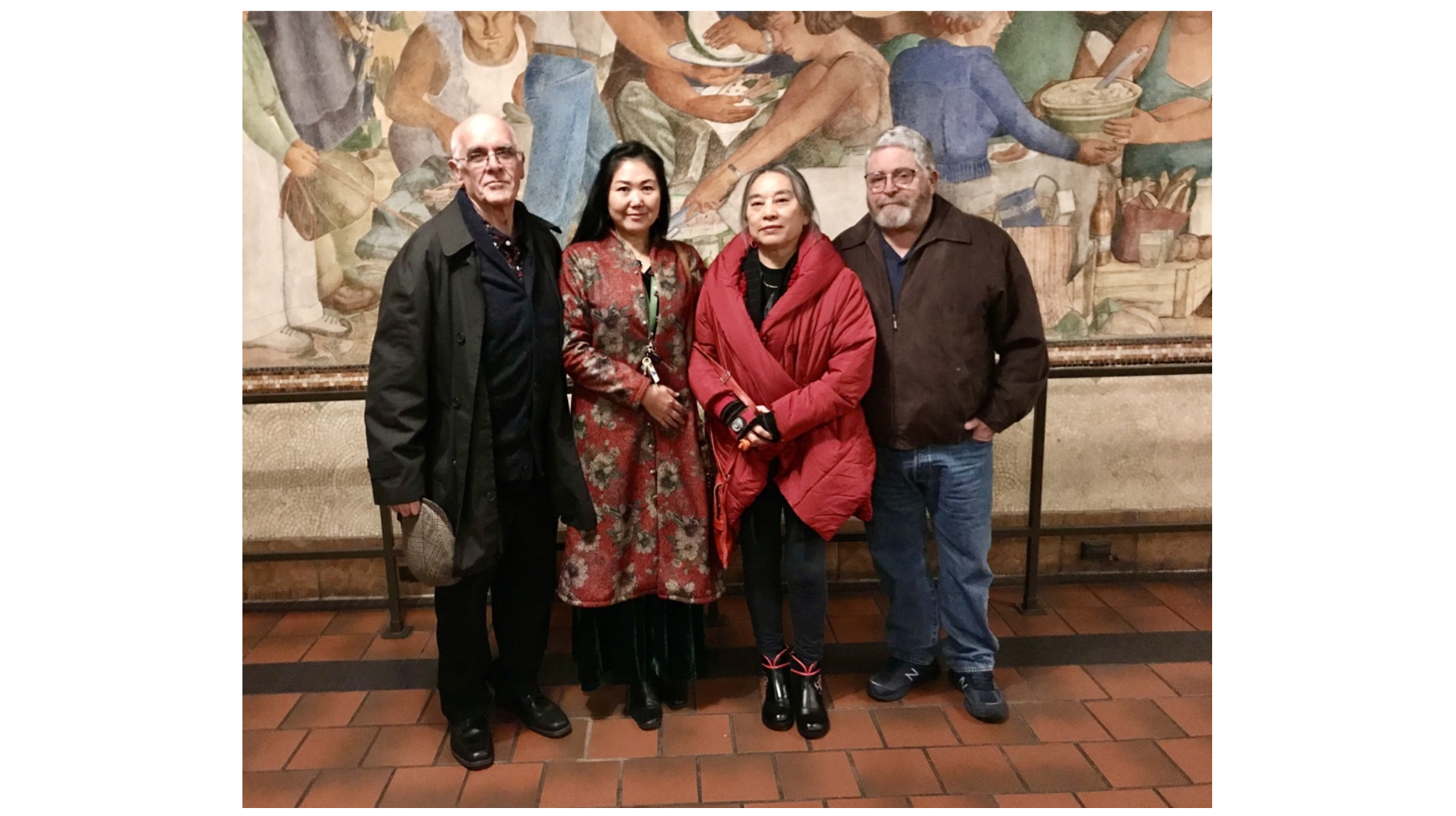
Gregory P. Collins | Lin Wei | Hung Liu | Jeff Kelley (2019)
LIN WEI
Chinese American Artist | Oil Painter | Educator
San Francisco, California
b. 1958, Shandong, China
ARTIST BIOGRAPHY
Lin Wei is a Chinese American artist who has lived and worked in the United States since 1993. Born in Shandong, China, into a family of teachers, she studied oil painting at Qufu Normal University and the Central Academy of Fine Arts in Beijing.
From 1983 to 1993, Lin Wei taught at Qufu Normal University and Shandong University of Arts. After moving to the United States, she was invited to serve as a short-term visiting lecturer at Mills College in Oakland, the University of California, Davis, City College of San Francisco, and San Francisco State University. Her lectures focused on painting techniques and the experiences and contributions of women artists across different cultures.
In 2007, she founded Asian Arts School in San Francisco, where she continues to teach drawing and painting to students of different ages and backgrounds while overseeing the school's art programs.
Her artistic practice reflects her experiences across cultures and her continuing interest in the relationship between people, society, and the world around them.
EDUCATION
Central Academy of Fine Arts, Beijing, China
Oil Painting
Qufu Normal University, Shandong, China
Oil Painting
TEACHING & ACADEMIC EXPERIENCE
Asian Arts School, San Francisco, CA
Founder & Director, 2007–Present
San Francisco State University, San Francisco, CA
Visiting Lecturer
City College of San Francisco, San Francisco, CA
Visiting Lecturer
University of California, Davis, Davis, CA
Visiting Lecturer
Mills College, Oakland, CA
Visiting Lecturer
Shandong University of Arts, Shandong, China
Faculty, 1983–1993
Qufu Normal University, Shandong, China
Faculty, 1983–1993
ARTISTIC PRACTICE
Primary Medium: Oil on Canvas
Lin Wei's paintings explore contemporary life through observations of people, movement, community, uncertainty, and the changing relationship between individuals and their surroundings. Drawing from her experiences of living between Chinese and American cultures, her work reflects an ongoing engagement with human experience, society, and the world around us.
SELECTED WORKS
The Body Becoming
Oil on Canvas, 20 × 20 in., 2026
In the Rain
Oil on Canvas, 14 × 11 in., 2026
FROM LIFE
Oil on Canvas, Triptych, 80 × 200 in., 2025
Unprecedented Times
Oil on Canvas, 36 × 48 in., 2025
Traffic in the Sky
Oil on Canvas, 20 × 16 in., 2024
A Moment from Life Drawing Class
Oil on Canvas, 18 × 24 in., 2023
Rescue a Chained Woman
Oil on Canvas, 40 × 60 in., 2022
Separation
Oil on Canvas, 36 × 40 in., 2022
The Thinker
Oil on Canvas, 24 × 18 in., 2020
The Prayer
Oil on Canvas, 41 × 33 in., 2020
SELECTED EXHIBITIONS
Superfine Art Fair
Fort Mason Center, San Francisco, CA, 2025, 2026
Red Dot Miami
Artavita / World Wide Art, Miami, FL, 2024
An Ordinary Notion
San Francisco, CA, 2024
California Landscape Exhibition
Sacramento, CA, 2024
About Face Exhibition
Bedford Gallery, Walnut Creek, CA, 2023
The World of Frida
Hudson River Museum, Yonkers, NY, 2022
The World of Frida
Bedford Gallery, Walnut Creek, CA, 2018
With Liberty and Justice for Some
Berkeley, CA, 2017
PROFESSIONAL PROFILE
Artist and educator with more than four decades of experience in oil painting, art education, and community-based arts programming. Founder and Director of Asian Arts School in San Francisco since 2007.
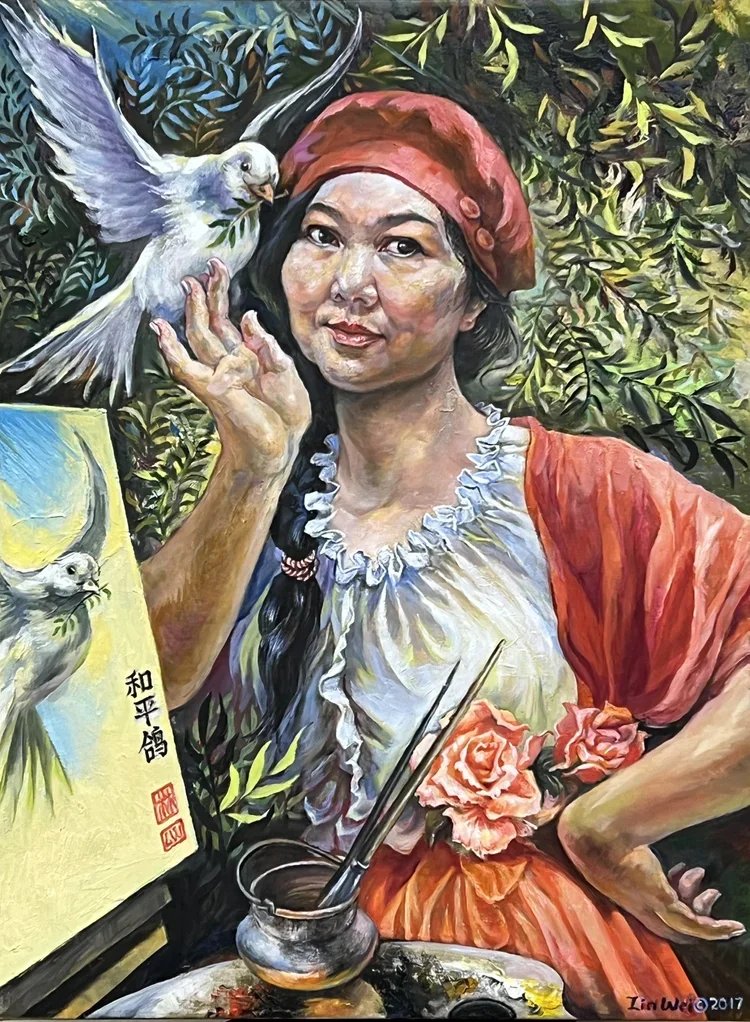
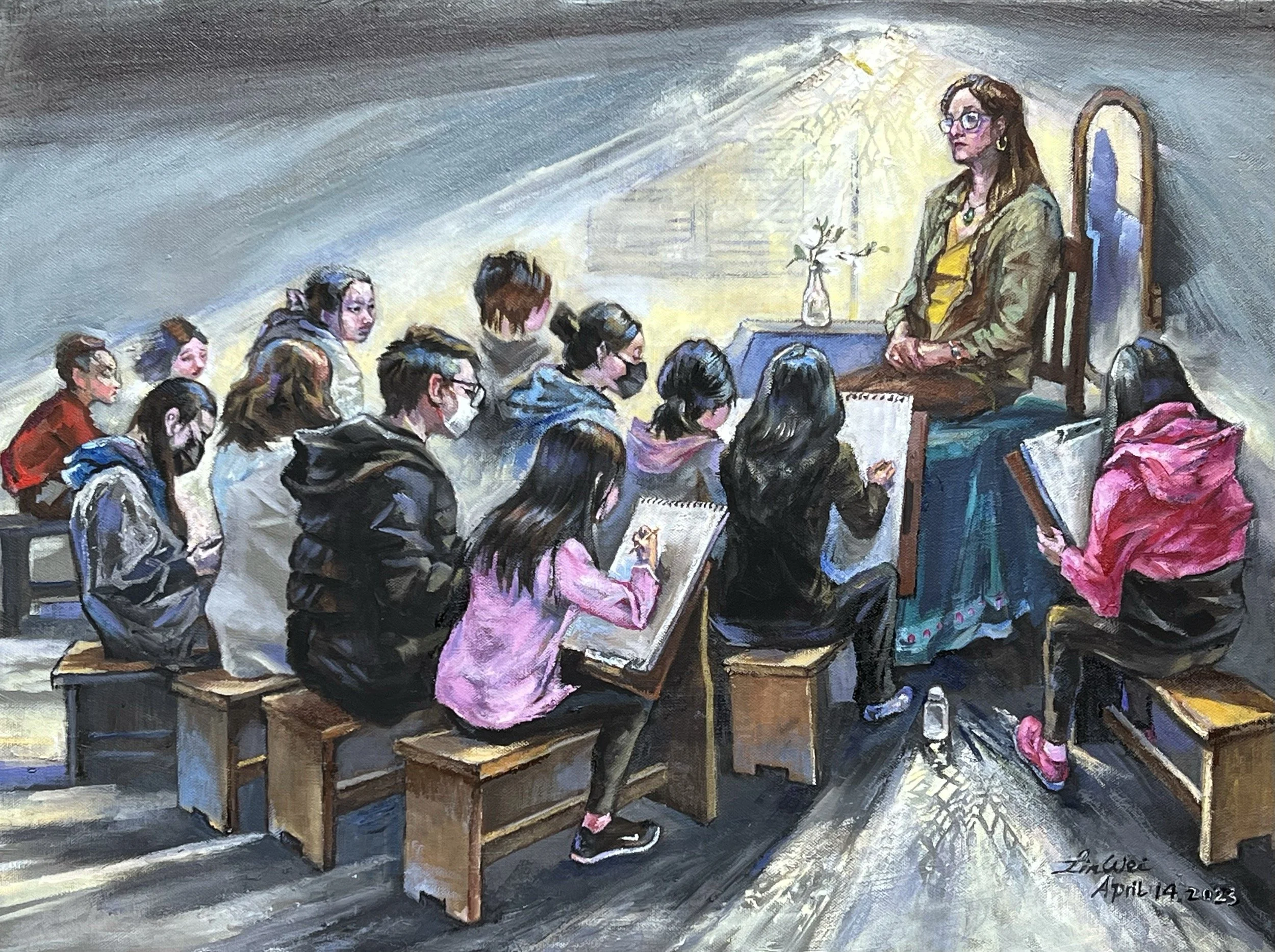
Lin Wei, The Dove, oil on canvas, size: 24×18", 2017 Lin Wei, A Moment from Life Drawing Class, oil on canvas, Size: 18”x 24”, 2023